At EID we are always on the lookout for “cross pollination” opportunities to enhance our perspective on planning. Recently I discovered some visitor centers promoting tourism that provided some interesting discoveries. My first discoveries took place at the Southern Arizona Heritage and Visitor Center, and then I discovered some excellent interpretive examples at Visitor Centers in Lexington, Kentucky, Kanab, Utah and Sunset Crater National Monument (Arizona). These sites had strong interpretive elements you might want to explore and replicate.

North Rim, Grand Canyon National Park, Arizona Photo Credit: Mike Mayer
Good Planning in Lexington, Kentucky
Lexington, Kentucky is where I grew up and I try to visit friends and family there once a year. With a couple of friends, we decided to walk through downtown Lexington to see what was new. Our first stop was the Lexington Visitor Center located in the historic Fayette County Courthouse. Many memories surround this courthouse for me. Across the street was the dentist’s office where my braces were put on, a few blocks away was the main library, in this courthouse I received my first driver’s license – lots of memories.

Current View of Historic Fayette County, Kentucky Courthouse Photo Credit: Wikipedia

Pre-2017 View of Historic Fayette County, KY Courthouse (Wikipedia)
The first piece of good planning I noticed was in front of the building. Like many courthouses in the South, statues of local Civil War heroes of the Confederacy were prominently displayed. Much to the credit of the Lexington-Fayette County Urban Government, the statues of John Hunt Morgan and John Breckenridge were quietly removed in 2017 and placed in a more appropriate location – the Lexington Cemetery. From an interpretive perspective it opened the front lawn of the Courthouse for events to enhance the mission of the Lexington Visitor Center and attract more local and out-of-town visitors to the site.
Even more impressive is the planning model utilized before any renovation work began on the inside of the visitor center. The space needed to incorporate Nine (9) Pillars that the community is known for, and wants visitors to experience while in the area:
· Arts & Culture
· Bourbon
· Culinary Experiences
· Family Friendly
· Horse Capital of the World
· History
· Music
· Outdoors
· Sports
It certainly makes this planner’s heart soar knowing careful thought went into mission, goals and Outcomes before the actual construction took place.
Here are the interpretive experiences I think helped support the 9 Pillars.

Entrance View, Lexington, KY Visitor Center Photo Credit: Lexington Visitor Center Website
Walking into a center for the first time I always wonder what is going to catch my attention. Besides the friendly greeting, colorful brochures and items for sale at this center, there was the wonder to behold along the back wall – The Holobox. It was an “Oh Wow!” moment indeed. There, speaking to me in a slightly larger than life image, was the Mayor of Lexington. Her five-minute talked welcomed me and she described what she liked to do in Lexington. Next was a local naturalist who described five things not to miss while in the area and five things they loved to do – also only 5 minutes long. There was a blues musician, restaurant and distillery owners, a horse farm executive and many more. It was quite captivating and gave me just enough information to pique my curiosity and want to explore the area.
Some other great features of the Holobox:
You can choose the person and topic you want to see and hear – it is not on a loop.
It can be programmed for different languages and this center offers English, Spanish, French, Arabic, and Japanese.
Director Abigal Waldron indicated that uploading the speaker’s video was not difficult and they plan on rotating individuals in and out to keep the information fresh.
Finally, if you can’t have the real person there (and now we are heading into the concept of “getting it into the concrete” advocated by Steve Van Matre in earth education and Interpretive Design and the Dance of Experience), get a as close as you can to the real thing. The Holobox makes that happen.
Smell the Difference

Smel the Bourbon, Lexington, KY Visitor Center Photo Credit: Mike Mayer
The making of bourbon in Kentucky is a big deal and is one of its signature products. There are 15 distilleries within a 50-mile radius (80 km) of Lexington. Of course, there are rules about where you can drink bourbon so no tasting in the Lexington Visitor Center. However, what about an olfactory flight set-up of bourbon? This unique display allows visitors to sample the smell of five different kinds of bourbon and to notice the differences in color. Pump a bit of air into the container, place the nose over the funnel and you get the next best thing to the real thing. So come on, take a whiff! This set-up also lends itself to offering different brands or even different smells over time.
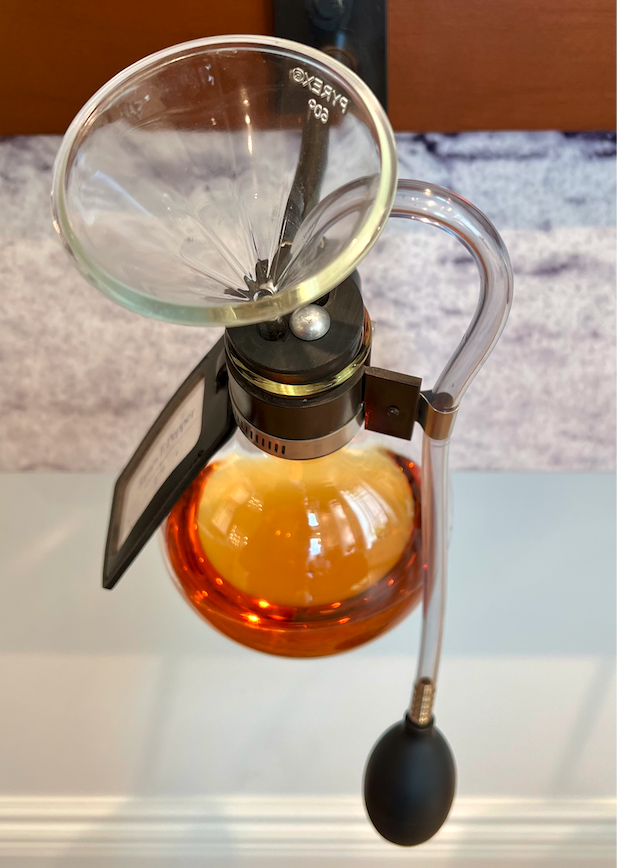
Smel the Bourbon, Lexington, KY Visitor Center Photo Credit: Mike Mayer
One Last Thing
You might notice there is a lot of blue at this visitor center. The University of Kentucky’s sports teams’ colors are blue and white. Because Lexington and the surrounding area are considered the Horse Capital of the World, horse images abound. While the goal of this visitor center is to promote visitation to the area and support the local economy, we in the field of interpretation need to take notice of the attention to planning and the focused displays that can be found in tourism so we can build a Sense of Place in preservation, collection and historic recognition sites.

Interior, Lexington, KY Visitor Center Picture Credit: Mike Mayer

Interior, Lexington, KY Visitor Center Photo Credit: Mike Mayer
Get It Into the Concrete
This mantra was drilled into us during graduate school in interpretive services and environmental education administration. Provide rich, first-hand experiences with the real thing whenever possible. If that can’t be done, get replicas or reproductions, and at the very least give folks a visual image to focus on. A visit to the Kanab, Utah Visitor Center had a couple of very concrete exhibits worth mentioning.

The Wave Photo Credit: Mike Mayer
For those of you not familiar with the area around Kanab, it is a gateway community to some of the most spectacular natural features and public lands in the United States: North Rim of the Grand Canyon, Bryce Canyon, Zion, The Wave, Vermillion Cliffs and lots more. There is also a rich history of Indigenous Peoples living in the area both in the past and in the present.
One display provided a hands-on experience of the colorful geography of the area. Next to the name of each rock layer was the actual rock mounted to the wall. The visitor could feel the texture and look closely at the layers and see many details.

Geology Display, Kanab, Utah Visitor Center Photo Credit: Mike Mayer
The cultural display provided an up close look of the different kinds of pottery made by the Indigenous Peoples with good examples of the differences in style and firing.

Pottery Display, Kanab, Utah Visitor Center Photo Credit: Mike Mayer
At nearby Pipe Springs National Monument (Utah) this visual display provided a valuable insight into the decline of the tribe’s population over the years using few words and strong visual images.

Signage, Pipe Springs National Monument Visitor Center, Utah Photo Credit: Mike Mayer
Along the North Rim of the Grand Canyon a sign provided information on how long this natural wonder had been around. In the corner was a visual of a boy with outstretched arms indicating significant geological time periods that led to the formation of the Grand Canyon.

Signage, North Rim, Grand Canyon National Park, Arizona Photo Credit: Mike Mayer

Sign Detail, North Rim, Grand Canyon National Park, Arizona Photo Credit: Mike Mayer
Important information using relatable images without too much text. Good work on the part of the interpretive planners.
Message Reinforcement at Sunset Crater Volcano National Monument

View of volcano at Sunset Crater Volcano National Monument, Arizona Photo Credit:Mike Mayer
How often does your site Reinforce the mission or important Outcomes for the Heart, Head, Hands and Habits in various experiences, displays or presentations? This is a key component when planning and designing visitor experiences, and the development of visitor activities should take place at the very end of the planning process. Just to recap the entire EID planning process from Interpretive Design and the Dance of Experience…
Þ First…are the site’s Mission, Message, and Image still relevant?
Þ Then…are the Receiving Steps -- Welcome, Orient, Guide - - in place?
Þ Next…what do you want folks to leave with in their Heart, Head, Hands, Hunger, Habits?
Þ Finally…develope the Producing Steps - the experiences:
· What kind of activity experience will best Achieve the desired Outcome?
· How will you to Motivate visitors to participate?
· What is the best way to Organize the experience and Outcomes?
· Where else will you Reinforce the Mission and Outcomes from this activity?
· Finally, how will you Evaluate the experiences to see if you have Achieved what you set out to do.
And that’s AMORE! (For more on AMORE see pages 240-241 in the book Interpretive Design and the Dance of Experience by Steve Van Matre)

Entrance View, Sunset Crater Volcano National Monument, Arizona Photo Credit: Mike Mayer
Back to Sunset Crater Volcano…Walking into the center it is very colorful, with lots of displays, and almost too much information crammed into the space. The 15-minute video on the site provided a nice mix of vulcanism, natural history and cultural insights to what happened 1200 years ago. In my opinion it was not too much information and was worth watching (though why do centers insist on uncomfortable benches to watch important information).
The Reinforcement happened on the trails. Some of the same information from the video was repeated almost word for word on signage along two of the trails we walked. Now the information was more powerful because it was right in front of us – the lava flow, the crater, vegetation, and views of where former Indigenous villages existed, and it was reinforced.

Reinforcing Signage, Sunset Crater Volcano National Monument, Arizona Photo Credit: Mike Mayer
If you made some interpretive discoveries in unexpected places, found some good examples of “in the concrete” displays, or Reinforcement of Outcomes, please share them with us and we will share them with others.

Historic Fayette County, KY Courthouse Photo Credit: Getty Images
To get more information on some of the places mentioned in this blog post follow the links below: